
How Horizontal Machining Centres Support Complex and Large Component Manufacturing
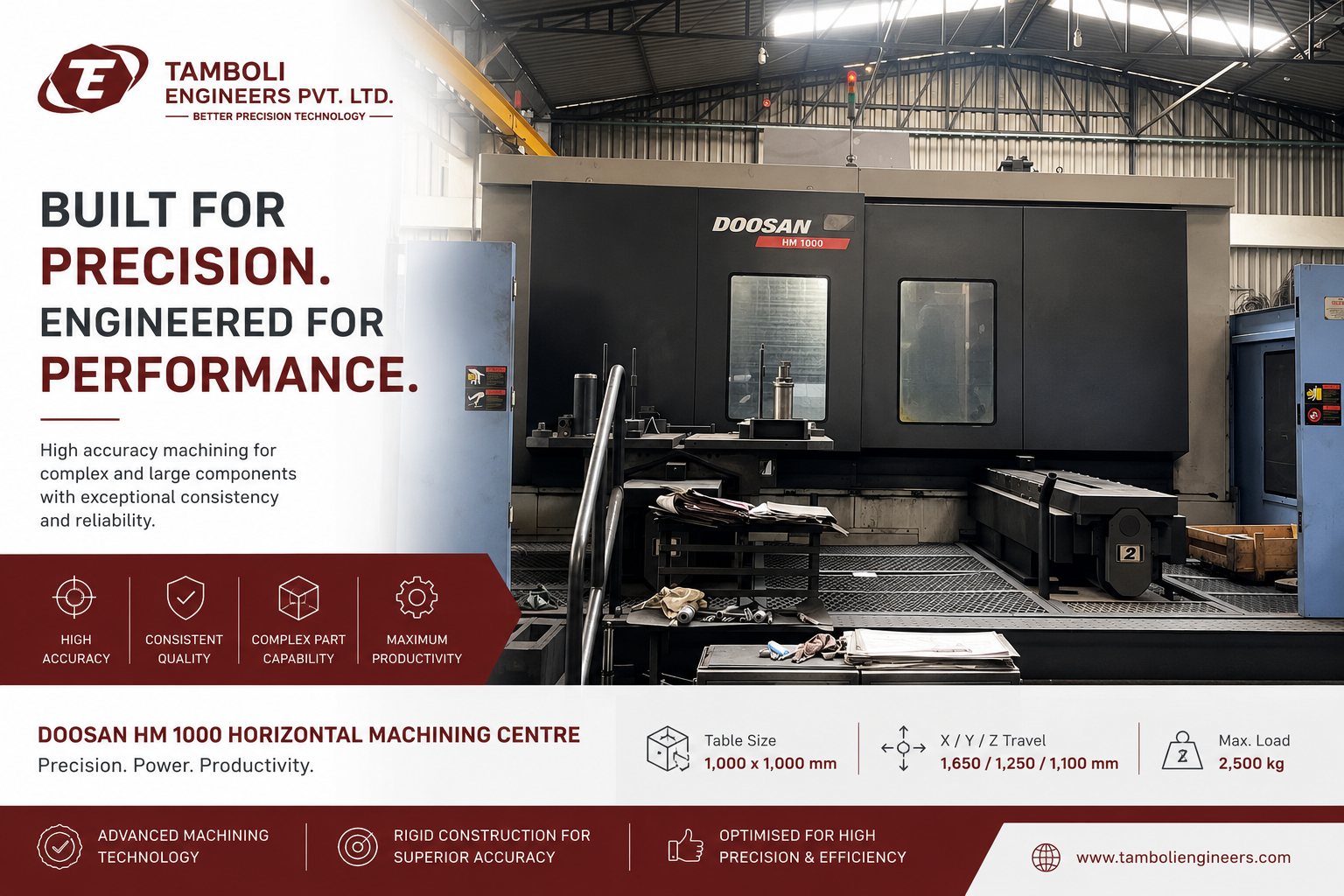
How Horizontal Machining Centres Support Complex and Large Component Manufacturing
Modern engineering often requires components with complex shapes, multiple machining surfaces and strict dimensional requirements. Producing these components efficiently requires the right combination of machinery, process planning, tooling and inspection. A horizontal machining centre is designed to perform multiple machining operations with accuracy and consistency. Its horizontal spindle arrangement provides effective access to different sides of a component and makes it suitable for demanding machining applications.
At Tamboli Engineers Pvt. Ltd., advanced machining infrastructure supports the manufacturing of precision and complex components for a range of industrial applications. The company has experience in precision CNC machined components, heavy castings and intricate components, supported by machining, inspection and assembly facilities.
What Is a Horizontal Machining Centre?
A horizontal machining centre is a CNC machine in which the spindle is positioned horizontally in relation to the workpiece. This arrangement allows cutting tools to approach the component from the side. Depending on the machine configuration and component setup, several machining operations can be carried out with fewer changes in workholding. These operations may include milling, drilling, boring, tapping and other precision machining processes.
Why Horizontal Machining Is Suitable for Complex Components
Complex engineering components often contain multiple holes, pockets, bores, surfaces and other features that must be machined accurately in relation to one another. Every time a component is removed and repositioned, additional setup and alignment are required. A well planned horizontal machining process can reduce the number of separate setups needed for certain components. This is important because fewer setups can help improve consistency between machined features. It can also reduce handling time and simplify the production process.
Supporting Large Component Machining
Large component machining presents different challenges compared with machining smaller parts. The size and weight of the workpiece can make loading, positioning, workholding and tool access more demanding. Machine capacity is only one part of the solution. Successful large component machining also depends on careful process planning, suitable fixtures, stable workholding and the correct machining sequence.
Horizontal machining centres can support applications where access to different features of a large or complex workpiece is important. Their configuration can help manufacturers plan machining operations around the geometry of the component while reducing unnecessary movement and handling. Tamboli Engineers' broader infrastructure also includes CNC horizontal boring and large machining capabilities. The company presentation lists a CNC horizontal boring machine with X travel of 4,000 mm, Y travel of 2,500 mm and Z travel of 2,000 mm, demonstrating its focus on substantial machining.
Precision Requires More Than Advanced Machinery
An advanced CNC machine is an important part of precision manufacturing, but the machine alone does not guarantee the required result.Accuracy begins with understanding the component drawing, material, geometry and critical dimensions. Engineers must then select the right tools, cutting parameters, fixtures and machining sequence. Workholding is especially important for large and complex components.
The workpiece must remain stable during machining while avoiding unnecessary distortion. Tool selection and process planning must also consider factors such as cutting forces, accessibility and the required surface finish. After machining, inspection provides confirmation that the component meets the required specifications. This is why machining and quality control should work as connected parts of the same manufacturing process.
Improving Efficiency Through Better Process Planning
Manufacturing efficiency is not simply about operating a machine at a higher speed. A more effective process aims to reduce unnecessary setups, handling, waiting time and repeated operations while maintaining the required quality. Horizontal machining centres can contribute to this approach by allowing multiple operations to be planned within a structured machining cycle. When the machine, tooling, fixture and program are properly coordinated, manufacturers can create a more consistent workflow. This becomes particularly valuable for components that require several machining operations or features on different surfaces.