
Precision CNC Turning for Critical Engineering Components
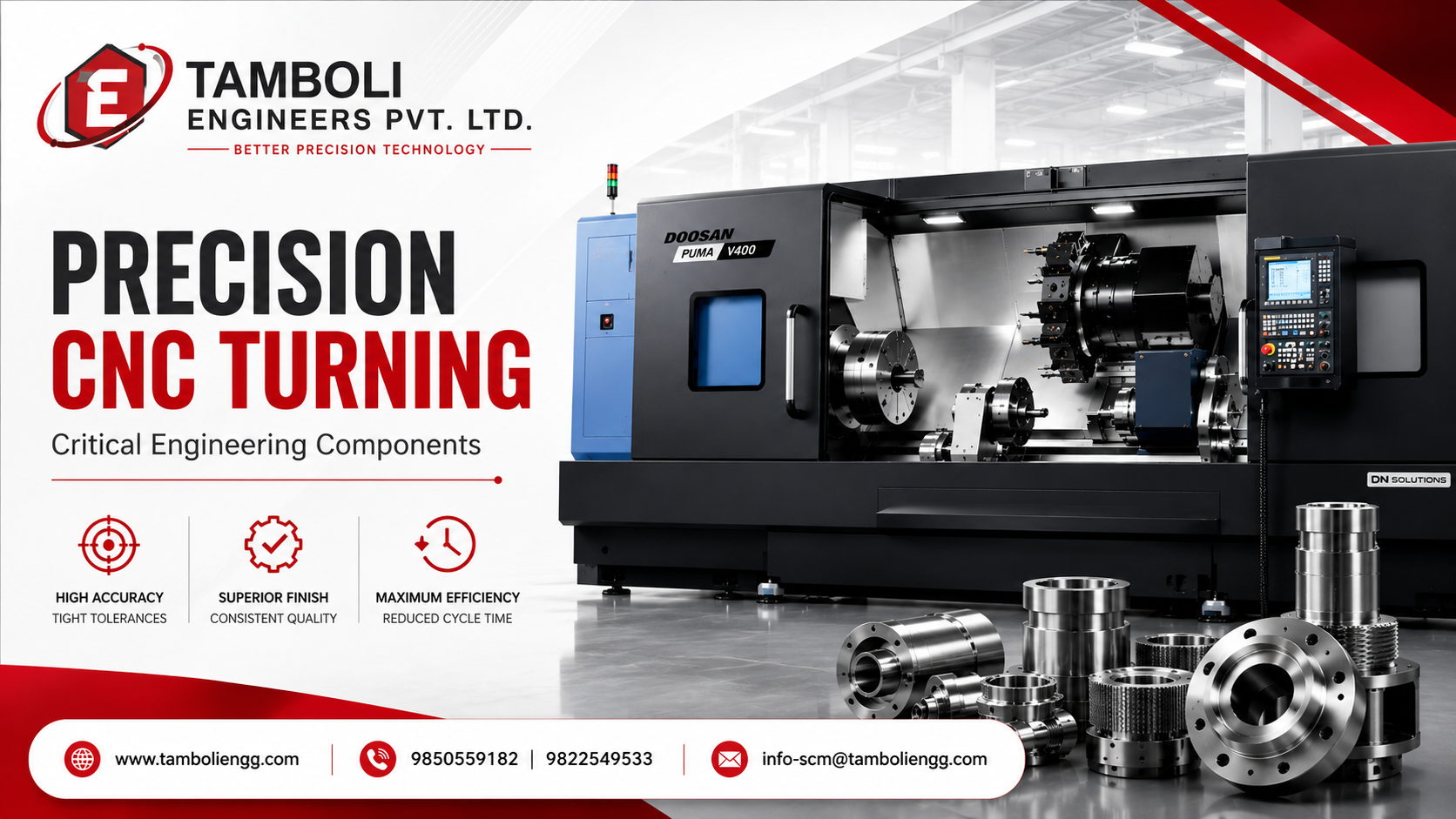
Precision CNC Turning for Critical Engineering Components
Precision engineering depends on manufacturing processes that can consistently produce components with exceptional dimensional accuracy and repeatability. Many industries require cylindrical parts, shafts, flanges, housings, bushings, sleeves, and other rotational components that must meet tight engineering tolerances while maintaining excellent surface finish.
Precision CNC Turning has become one of the most reliable manufacturing processes for producing these components efficiently and accurately. Using advanced CNC turning centres, manufacturers can machine complex parts with high consistency while reducing production time and maintaining superior quality standards.
At Tamboli Engineers, modern CNC Turning Centres support the production of precision-engineered components for industries where quality, reliability, and dimensional accuracy are essential.
What Is Precision CNC Turning?
Precision CNC Turning is a machining process where a workpiece rotates while stationary cutting tools remove material to achieve the required dimensions and surface finish.
Unlike conventional manual turning, CNC turning uses computer-controlled programming that allows every machining operation to follow precise tool paths with exceptional repeatability.
Modern CNC Turning Centres perform multiple operations in a single setup, including:
· External turning
· Internal boring
· Facing
· Grooving
· Thread cutting
· Drilling
· Chamfering
This automation improves production efficiency while maintaining consistent quality across every component.
Why CNC Turning Is Important in Precision Engineering
Many industrial components rely on perfect concentricity, smooth surface finish, and precise diameters to function correctly.
Even minor dimensional variations can affect assembly, bearing performance, sealing efficiency, or rotational balance.
Precision CNC Turning helps manufacturers maintain:
· Tight dimensional tolerances
· Excellent roundness
· Superior concentricity
· High-quality surface finish
· Consistent repeatability
These characteristics are essential for components used in demanding industrial environments.
Components Manufactured Using CNC Turning
Precision CNC Turning is suitable for manufacturing a wide range of engineering components, including:
· Shafts
· Sleeves
· Bushes
· Flanges
· Bearing housings
· Rollers
· Hydraulic components
· Pump parts
· Valve components
· Machine spindles
Many of these components require multiple machining operations that can be completed efficiently within a single CNC turning cycle.
Advantages of Precision CNC Turning
Modern CNC Turning Centres provide several benefits that improve manufacturing quality and productivity.
High Dimensional Accuracy
Computer-controlled machining ensures every component meets the required engineering specifications with minimal variation.
Better Surface Finish
Stable machining conditions and precise cutting parameters produce smooth surfaces, reducing the need for secondary finishing operations.
Faster Production
Automatic tool changing and programmable machining cycles reduce production time while maintaining consistent quality.
Reduced Human Error
Once the machining program is validated, identical components can be produced repeatedly with minimal operator intervention.
Cost-Effective Manufacturing
Higher productivity, lower rejection rates, and reduced setup times help improve overall manufacturing efficiency.
Serving Critical Industries
Precision CNC Turning supports industries where component accuracy directly affects equipment performance and reliability.
Typical applications include:
· Aerospace
· Defence
· Oil & Gas
· Marine
· Mining
· Power Generation
· Heavy Engineering
· Industrial Equipment Manufacturing
These industries require precision-machined components capable of performing under demanding operating conditions.
Precision Inspection Ensures Quality
Machining accuracy must always be verified before components are delivered to customers.
After CNC turning operations are completed, critical dimensions are inspected using advanced measuring equipment to ensure compliance with engineering drawings and customer specifications.
This quality inspection process helps eliminate dimensional deviations while maintaining consistent manufacturing standards across every production batch.
Combining advanced CNC Turning Centres with precision inspection enables manufacturers to deliver reliable engineering components that meet demanding industrial requirements.
Why Manufacturers Choose Tamboli Engineers
Successful precision machining requires advanced technology, experienced engineers, and a strong commitment to quality.
Tamboli Engineers combines modern CNC Turning Centres with precision inspection systems and proven manufacturing expertise to produce high-quality engineering components for customers across multiple industrial sectors.
By continuously investing in advanced machining infrastructure and quality assurance processes, the company delivers components that meet strict engineering standards while supporting reliable industrial performance.